

If you’ve got an app idea, you probably also have a quiet worry sitting next to it.
What if I build the whole thing and nobody wants it?
That worry is the smartest thing about you. Most people ignore it, build for six months, launch to silence, and decide they’re “just not a tech person.” You’re not going to do that. We’re going to answer the worry first, this week, in an afternoon.
Here’s the good news I wish someone had told me sooner: you do not need to be technical to launch a real consumer app. You need to be the person who makes good decisions and points the work in the right direction. The typing can be done by AI agents now. The deciding is the job. And the first decision is the one that saves you the most pain: is this idea worth building at all?
Where this sits in the whole journey
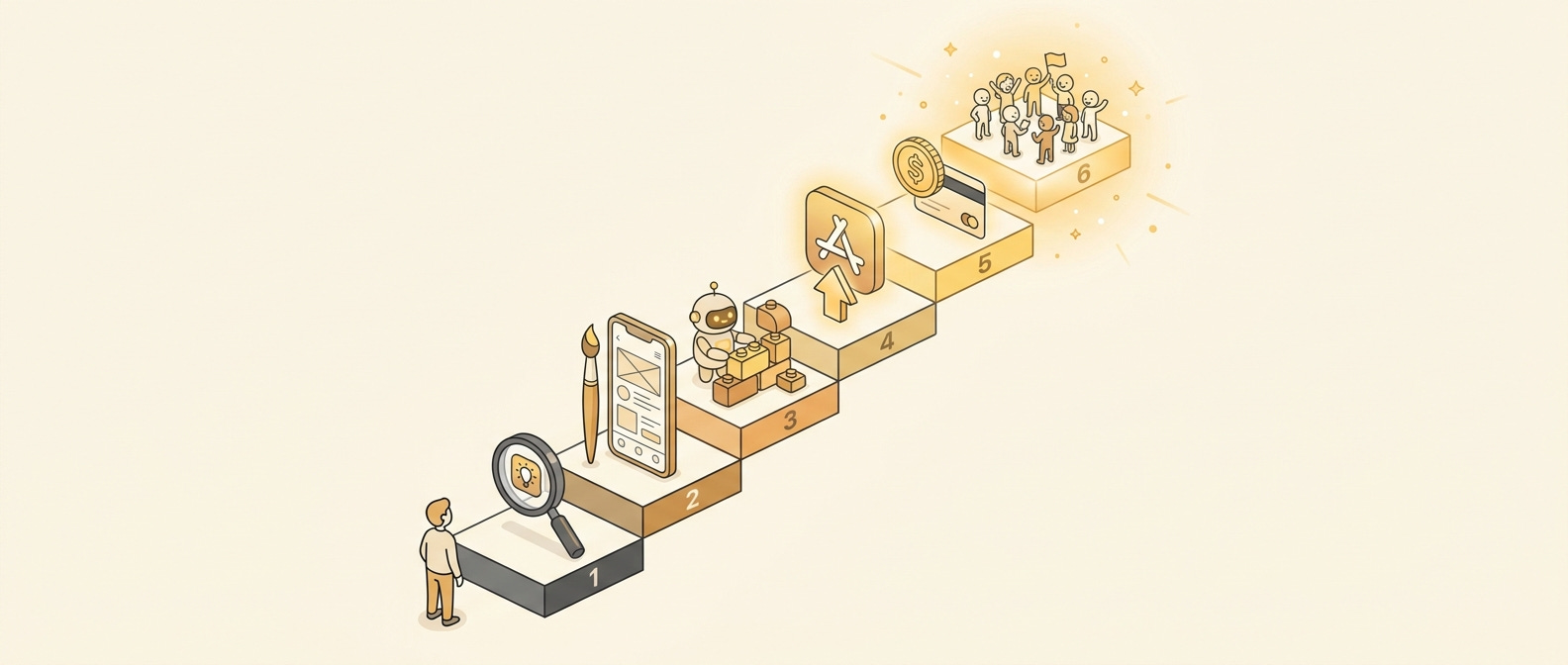
This series walks the entire path from “I have an idea” to “my app is live and earning,” in six steps:
1. Validate - is the idea worth building? (you are here)
2. Design - make something you’re proud of, without a designer
3. Build - ship it with AI agents directing the code
4. Ship - get it on the App Store
5. Money - get people to actually pay
6. Growth - your first 1,000 users
One step per post. No skipping. Today is step one, and step one is the cheapest insurance you’ll ever buy.
Validation is not asking your friends
Here’s the trap. You describe your idea to friends, they say “oh that’s cool, I’d use that,” and you feel great. That feedback is worthless. Your friends are being kind. Kind isn’t the same as a download, and a download isn’t the same as a payment.
Real validation answers four questions with evidence, not opinions:
1. Are people already looking for this? (demand exists)
2. Are the existing apps letting them down? (there’s a gap)
3. Is the gap something people complain about out loud? (real pain)
4. Would someone pay to make the pain go away? (real money)
You can check all four from your couch, on your phone, for free, before you build anything. Let me show you how the first one works, then I’ll hand you the full step-by-step playbook for all four.
The free version: read the one-star reviews
Open the App Store. Search the words a real person would use to describe your idea, not your clever product name, the *problem*. If your idea is “an app that helps new dog owners with training,” search “puppy training.”
Look at the top few apps. Two things tell you almost everything:
- How many ratings they have. Thousands of ratings means real demand exists. Zero apps, or only tiny ones, can mean no demand or a wide-open gap. You’ll learn to tell the difference in the playbook.
- What the one-star and two-star reviews say. This is the gold. People who are angry enough to leave a bad review will tell you, in their own words, exactly what’s missing. “Great idea but it crashes.” “Why is everything locked behind a subscription?” “Too complicated, I just wanted X.” Every complaint is a feature you could build, in the customer’s own language.
Spend twenty minutes reading bad reviews of the apps closest to your idea. Write down every complaint you see more than once. That list is the beginning of your product, and it’s written in words real buyers actually use.
That’s the overview, and it’s genuinely enough to start today. But “read some reviews” isn’t a plan. The full step-by-step playbook below turns these four questions into an afternoon you can actually follow — the exact searches, a free way to gauge how big the market is, the name-collision check that stops you naming your app something that’s already taken, and a one-page worksheet that gives you a clear go / no-go answer by tonight.
